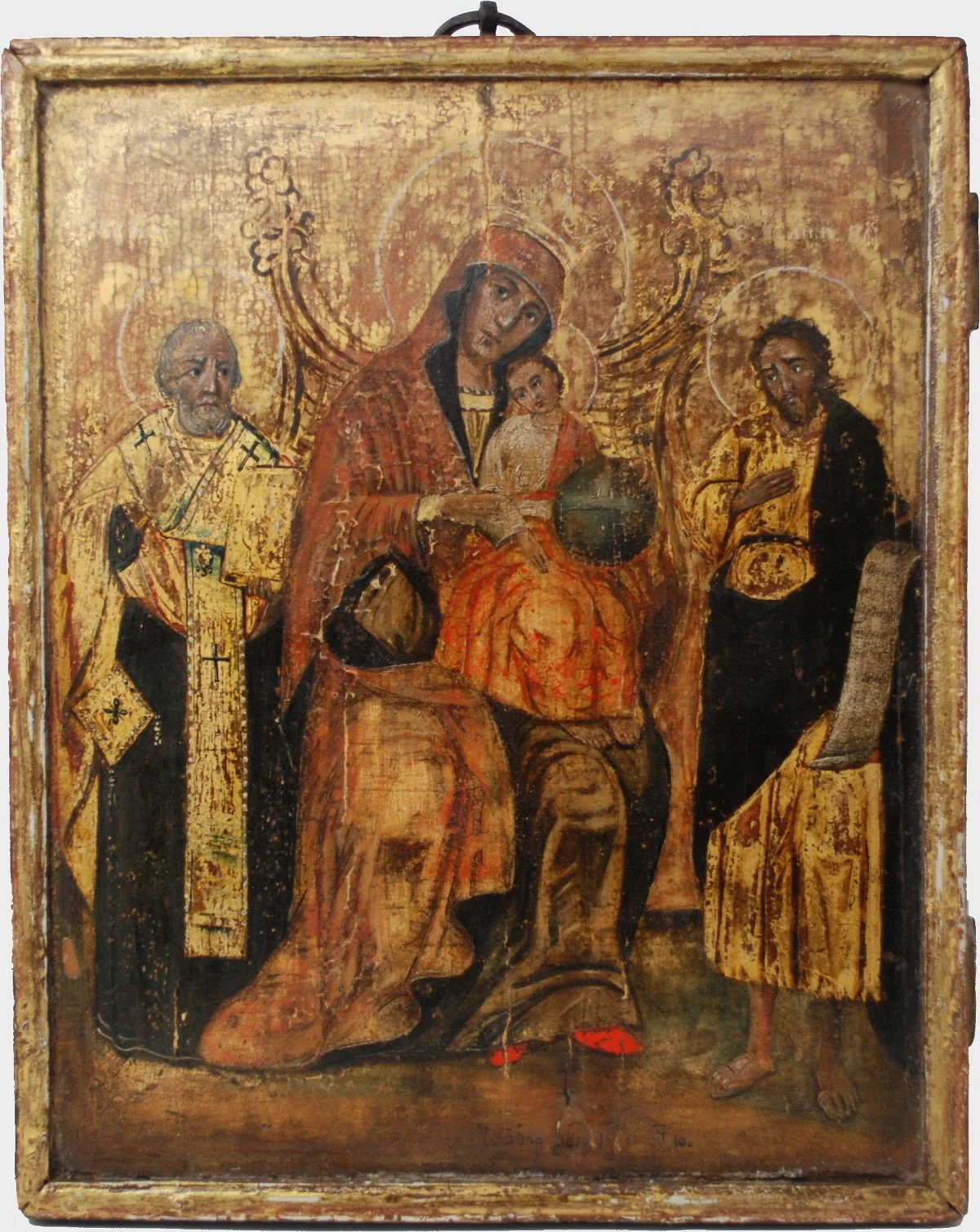
In Romanian and wider Orthodox tradition, the icon has always stood at the heart of the home — present at baptisms, weddings, and house blessings. Alongside ancestral customs, a few clear liturgical principles and proper conservation habits ensure both respectful veneration and long-term preservation of antique pieces.
1. Blessing & Placing Icons in the Home
- Church blessing: Before placing a newly painted or gifted icon in a prayer corner, it is customarily brought to church for blessing with holy water. An antique icon that has already been consecrated does not require re-blessing.
- The eastern wall: Orthodox tradition places the icon corner on the eastern wall (symbolizing the rising light and the church altar). Where home architecture does not permit this, choose a clean, quiet wall free of clutter.
- Traditional arrangement: Following the church iconostasis order, when placing the two principal icons side by side, Christ the Savior stands on the right (facing the wall) and the Mother of God with Child on the left, with family patron saints beside or immediately beneath.
- A dignified setting: Icons are kept separate from posters, family photographs, or everyday decorative knick-knacks and are not placed above televisions or busy domestic appliances.
2. Romanian Heritage Customs
- Wedding & housewarming icons: Parents or godparents traditionally gift newlyweds an icon (often the Mother of God, Christ, or Saints Constantine and Helena) to bless their new household. When moving into a new home, custom holds that the icon should be the very first object carried across the threshold.
- Baptism & name-day icons: Godparents present a child with the icon of their patron saint as a lifelong spiritual guardian.
- Woven towel & vigil lamp: In traditional Romanian homes, the principal icon was draped with a finely woven linen or raw-silk towel (ștergar) and illuminated by an oil vigil lamp on feast eves and Sundays.
3. Museum Conservation: How to Care for an Antique Icon
If you own a family heirloom or a 17th–19th century collector icon on wood, follow four essential museum conservation rules:
- Never clean with water, alcohol, oil, or household polishes! Egg tempera and gesso (levkas) are highly sensitive to moisture and solvents; remove surface dust only gently with a soft, completely dry natural-bristle brush.
- Watch vigil lamps & candles: An open flame placed too close irreversibly blackens varnish and can blister paint layers through heat. Maintain a safe clearance of at least 30–40 cm.
- Avoid rapid temperature & humidity swings: Never hang an antique wooden icon above a radiator, near a stove, in direct drafts, or in harsh direct sunlight (ideal relative humidity is 45–55%).
- What if an icon is damaged? An antique wood panel with cracks, woodworm, or flaking paint can be stabilized through professional conservation. Completely deteriorated paper prints are never discarded in household trash — they are brought to a church for respectful liturgical burning.
Do you own a family heirloom icon and wish to request an expert appraisal or restoration guidance? Contact our specialists directly via our Appraisals & Acquisitions page.