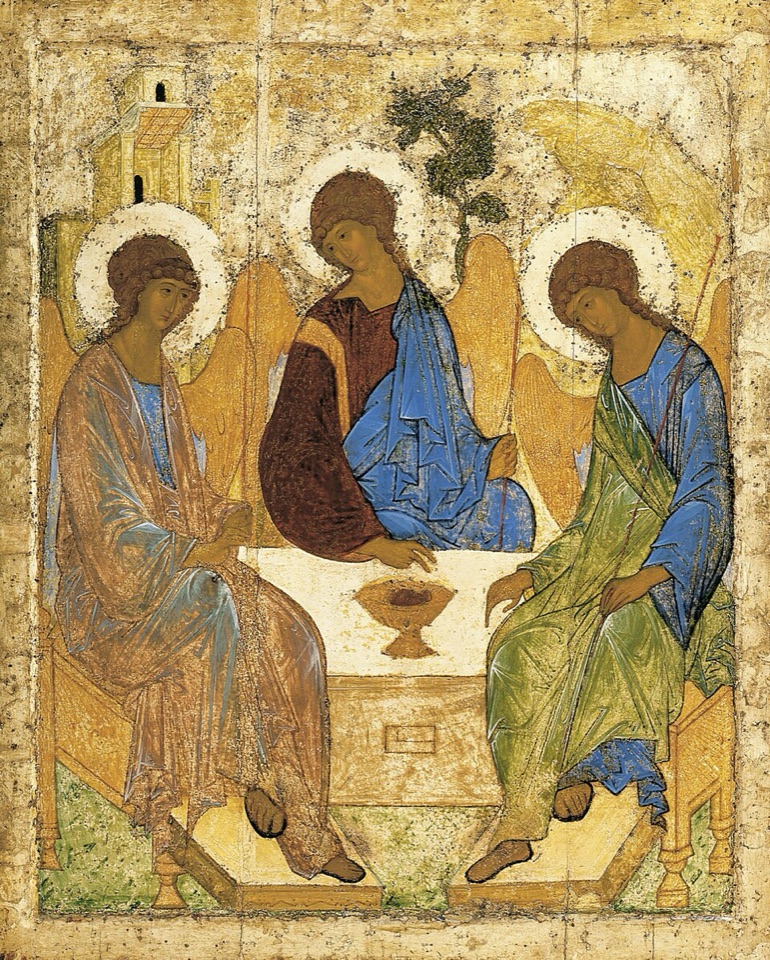
A natural question for any admirer of antique sacred art is: how did icon painters separated by centuries and thousands of miles depict the same feasts and saints with such remarkable visual harmony? The answer lies in the Hermeneia (Romanian: Erminii) — the traditional manuals of Byzantine and Orthodox church painters.
1. What Is a Hermeneia (Painter's Manual)?
Derived from the Greek hermēneia (ἑρμηνεία — “interpretation”, “explanation”, “guide”), a painter's manual is not a rigid template suppressing creativity, but a treasury of workshop craft and liturgical memory structured in two parts:
- Technical section (recipes): How to prepare wooden boards, glues, gesso (levkas), mineral pigments, gold leaf, oil varnishes, and lime plaster for frescoes.
- Iconographic section: Descriptions of Old and New Testament cycles, Great Feasts, the canonical appearance of saints (age, beard, vestments, attributes), and exact scriptural inscriptions.
2. Dionysius of Fourna & “The Painter's Manual”
The most celebrated treatise of this tradition belongs to the Greek hieromonk and iconographer Dionysius of Fourna (b. c. 1670 in Fourna, Agrafa – d. after 1744). Trained on Mount Athos, Dionysius compiled between roughly 1730 and 1734 the living knowledge of Athonite workshops and older manuscripts in his Hermēneia tēs zōgraphikēs technēs — widely known in English as “The Painter's Manual”.
Dionysius extols as his supreme exemplar the legendary master of the Macedonian School, Manuel Panselinos (active early 14th century, author of the frescoes at the Protaton Church in Karyes, Mount Athos). Circulated extensively in manuscript copies and translated into Romanian, Russian, French, German, and English (first printed in the West by Adolphe Napoléon Didron in 1845), Dionysius's manual remains indispensable to iconographers, art historians, and conservators alike.
3. Great Master Iconographers & Landmark Treatises
- Manuel Panselinos (14th c., Thessaloniki / Mount Athos): The benchmark of noble naturalism and monumental grace in Palaiologan painting.
- Theophanes the Greek (c. 1340–1410): Byzantine master who brought Constantinople's energetic brushwork and dramatic light highlights to Novgorod and Moscow.
- Saint Andrei Rublev (c. 1360–1430): Collaborator of Theophanes the Greek and creator of the immortal Holy Trinity icon (c. 1411), an unmatched synthesis of serenity, rhythm, and theology.
- Theophanes the Cretan (c. 1490–1559): Leading figure of the Cretan School who painted the great Athonite monasteries (Great Lavra, Stavronikita) and Meteora.
- Simon Ushakov (1626–1686): Master of the Moscow Kremlin Armory and author of a treatise on painting who introduced subtle, lifelike facial modeling into Russian iconography.
4. Painter's Manuals & Masters in the Romanian Lands
The Romanian Principalities played an extraordinary role in preserving and enriching the Hermeneia tradition. Already in the 18th century, Dionysius of Fourna's text was translated and expanded into Romanian by scholar-painters such as Archdeacon Macarie (the Căldărușani translation, 1805), Radu Zugravu (whose famous model notebook is preserved at the Romanian Academy Library), and Gheorghe Zograf. Alongside them, masters such as Dobromir of Târgoviște (16th c.) and Pârvu Mutu Zugravul (1657–1735, the preeminent painter of the Brâncovenesc era) endowed antique Romanian icons with their unmistakable warmth and elegance.
Understanding the Hermeneia enables collectors today to recognize not only what an antique icon depicts, but also how it was crafted and which regional workshop produced it.